
IoT Weighbridge Integration Software for the whole yard
Register your scales, trackers and sensors in one place, push their readings to an open endpoint, and see them live against your yard data. Vendor-neutral by design.
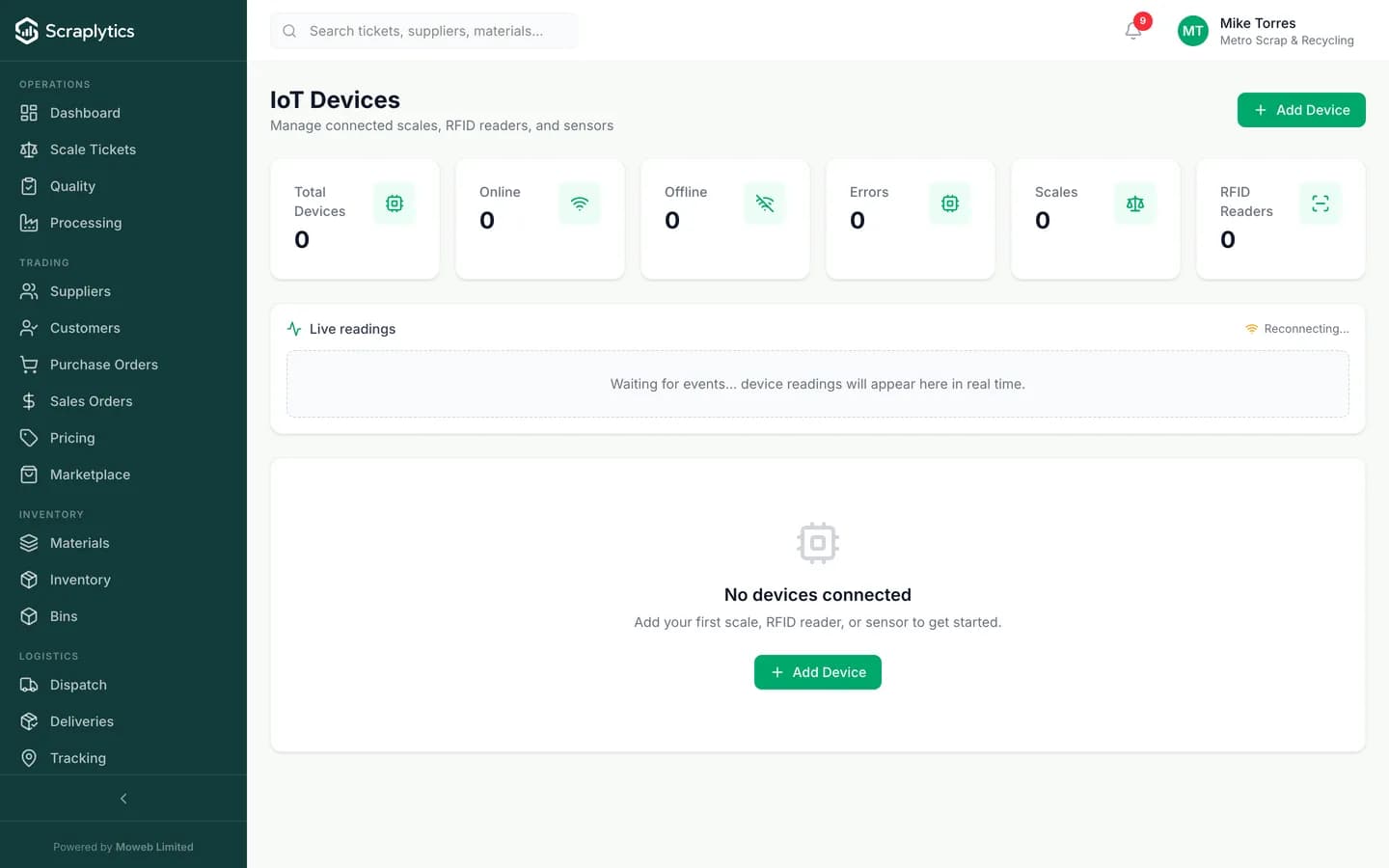
Live device telemetry, health monitoring, calibration audit log.
Why IoT weighbridge integration is the highest-ROI move in a yard
Hardware already exists at the yard. The cost of NOT integrating it is the transcription error, the bypass, the calibration drift nobody noticed.
Your weighbridge, your GPS trackers and your yard paperwork each live in a different place, so nobody can line a reading up against the load it belongs to.
Register each device once, then push its readings to one endpoint. Readings land against your tenant with a timestamp, so a weight or a location can be traced back to the device that produced it.
Insurance audit asks for the GPS trail of last week's loads. Your fleet GPS lives in one vendor portal, your dispatch lives in another, the two never talked.
The platform ingests GPS pings from your existing trackers and binds them to dispatch jobs. The GPS trail per load is two clicks - geocoded, timestamped, exportable.
Baler controller knows exactly how many bales were produced and what they weighed. The information lives on the controller's LCD and dies there. Production reports are guessed.
The baler PLC pushes telemetry to the work order. Bale count, individual bale weights, machine downtime - all captured live and rolled into the production yield report.
Inside the IoT layer
Every protocol scrap yards actually use
The ingestion API is deliberately vendor-neutral: any device, gateway or PC that can make an HTTPS POST with a JSON body can send readings. That covers most modern indicators with a network option, GPS trackers, and anything you can put a small script in front of. Connecting a specific serial-only indicator is an integration project we scope with you, not something that works out of the box today.
Edge gateway for sites with bad connectivity
Because ingestion is a plain HTTPS POST, whatever sits at your scale controls the buffering. If a site has unreliable connectivity, the gateway script you run there can queue readings and send them when the link returns. We do not ship that gateway today - it is part of an integration engagement, and we will tell you honestly what it involves for your hardware.
Device health that surfaces problems before they hurt
Each device carries its status, its last reading, and its calibration dates - last calibrated, next due, certification number. That turns "when was the weighbridge last certified?" from a filing-cabinet question into a screen, which is usually the first thing an auditor asks.
What you get
Frequently asked questions
Will it work with my existing weighbridge?+
It depends on your indicator. If it can reach the network, or you have a PC at the scale that can run a small script, it can push readings to us. Purely serial indicators need a piece in the middle. Tell us the make and model and we will give you a straight answer rather than a maybe.
Do I need to buy specific hardware?+
Not from us. If your indicator is network-capable, nothing extra is needed. If it is serial-only, you will need something at the scale to read it and forward it - typically the PC already sitting in the weighbridge office. We scope that with you up front.
Can I integrate non-scale devices like cameras or GPS?+
GPS trackers and sensors, yes - anything that can POST JSON. Cameras are a different matter: there is no video, live-feed or CCTV integration in the platform today. Operators can attach photos to a scale ticket from the phone or tablet they are already using, which covers the evidence use case but is not CCTV.
What happens if a device sends a bad reading?+
Each device has plausibility rules (weight in expected range, change vs last reading within X%, etc.). Out-of-range readings are flagged at the cashier rather than silently posted. The audit log preserves the original reading so calibration drift can be diagnosed.

Ready to modernize your scrap yard?
Start your 14-day free trial today and be writing digital tickets by tomorrow. No credit card, no contract.
- No credit card required
- 14-day free trial
- Cancel anytime