
Scrap Yard Compliance Software, built into the workflow
Scrap yard compliance software with ID capture, hold periods, OFAC screening, cash payment limits and a tamper-evident audit log. Rules enforced at the moment of action, not at the end-of-month review.
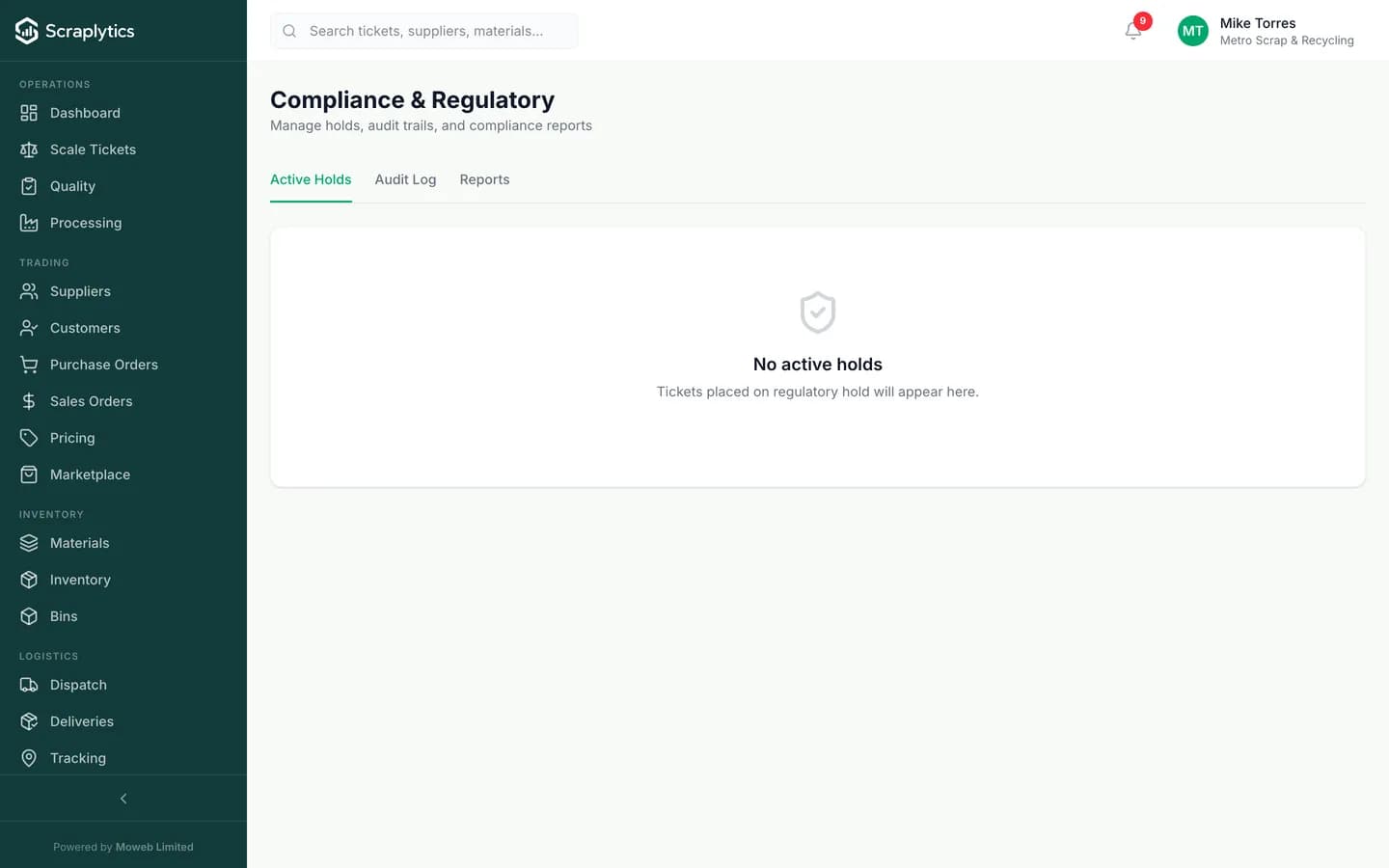
KYB, hold periods, screening hits, audit trail - one screen.
Why scrap yard compliance software cannot be a spreadsheet
Scrap is regulated like a financial industry without the systems. The cost of a missed check is not the fine - it is the operational pause when an investigator arrives without notice.
Police or insurance investigator shows up asking for the load history of a specific peddler. You spend the afternoon scrolling through paper tickets and a half-remembered Excel.
Search by ID, license plate, phone, name. Every load they ever brought - with photos, weights, payments and timestamps - is on one screen. The investigator leaves in 20 minutes with a printout.
State changes the hold period rule for catalytic converters from 3 days to 7. You announce it in a team meeting, two operators miss it, you take a fine.
Hold periods are configured in one settings screen. The cashier physically cannot mark a held lot as releasable before the configured window expires. Rule changes propagate instantly to every site.
Auditor asks "show me that you screen new suppliers against OFAC." You stare at the floor because the screening was supposed to be done by Bob, who left in March.
OFAC and sanctions screening runs automatically on every new supplier registration. Hits get flagged for review before the account can transact. The audit log shows every screening result.
Inside the compliance engine
Audit log that captures who, what and when on every record
Every create, update, delete, payment and approval is logged with the actor, the timestamp, and a diff of what changed. Logs are append-only and tamper-evident (signed in a hash chain). Whether the investigator is internal, external or regulatory, the answer to "who touched this record" is one query.
Hold periods and waiting rules that enforce themselves
Configurable per material and per jurisdiction: 3-day hold on copper, 5-day on catalytic converters, ID-on-file rule for cash purchases above $200, max-cash-per-day limits. The cashier interface respects every rule automatically. You stop relying on training and start relying on the system.
Screening that fires before transactions, not after
OFAC SDN, EU sanctions, UN sanctions, and PEP databases are screened on every new supplier and customer at registration, then re-screened on a configurable cadence (default monthly). Matches trigger a hold on the account pending review. Reviewer sees the match details, can document the decision, and the audit log captures it all.
What you get
Frequently asked questions
Which compliance regimes does this cover?+
US state scrap-metal laws (Texas, Ohio, California, etc.), UK Scrap Metal Dealers Act 2013, India hazardous waste rules, EU WEEE/WSR, UAE Dubai Municipality. The configurable rule packs cover the major regimes; the underlying audit log and hold mechanics work everywhere.
How is the audit log protected against tampering?+
Each log entry is hashed and chained to the previous entry. Any modification to a past log entry invalidates the chain from that point on, which is detectable. Logs are also append-only at the database level - the application has no delete or update path for log entries.
Can we export compliance data for a regulator?+
Yes. One-click exports cover the standard requests: transaction registers by date range, ID verification logs, hold-period registers, OFAC screening results, cash payment summaries. Custom export templates can be added for specific regulator formats.
Does ID capture work on mobile?+
Yes. The Manager and Scale-house apps include a structured ID capture: photo of front and back, OCR of name/DOB/license number, signature on glass. Capture happens at the scale; the operator never has to type any of it.

Ready to modernize your scrap yard?
Start your 14-day free trial today and be writing digital tickets by tomorrow. No credit card, no contract.
- No credit card required
- 14-day free trial
- Cancel anytime