
Scrap Carbon Tracking Software you can actually report
Scrap carbon tracking software that computes CO2 avoided, landfill diverted and energy saved per transaction. Auditable numbers, exportable in the formats your customers and regulators (GRI, CDP, ISSB) demand.
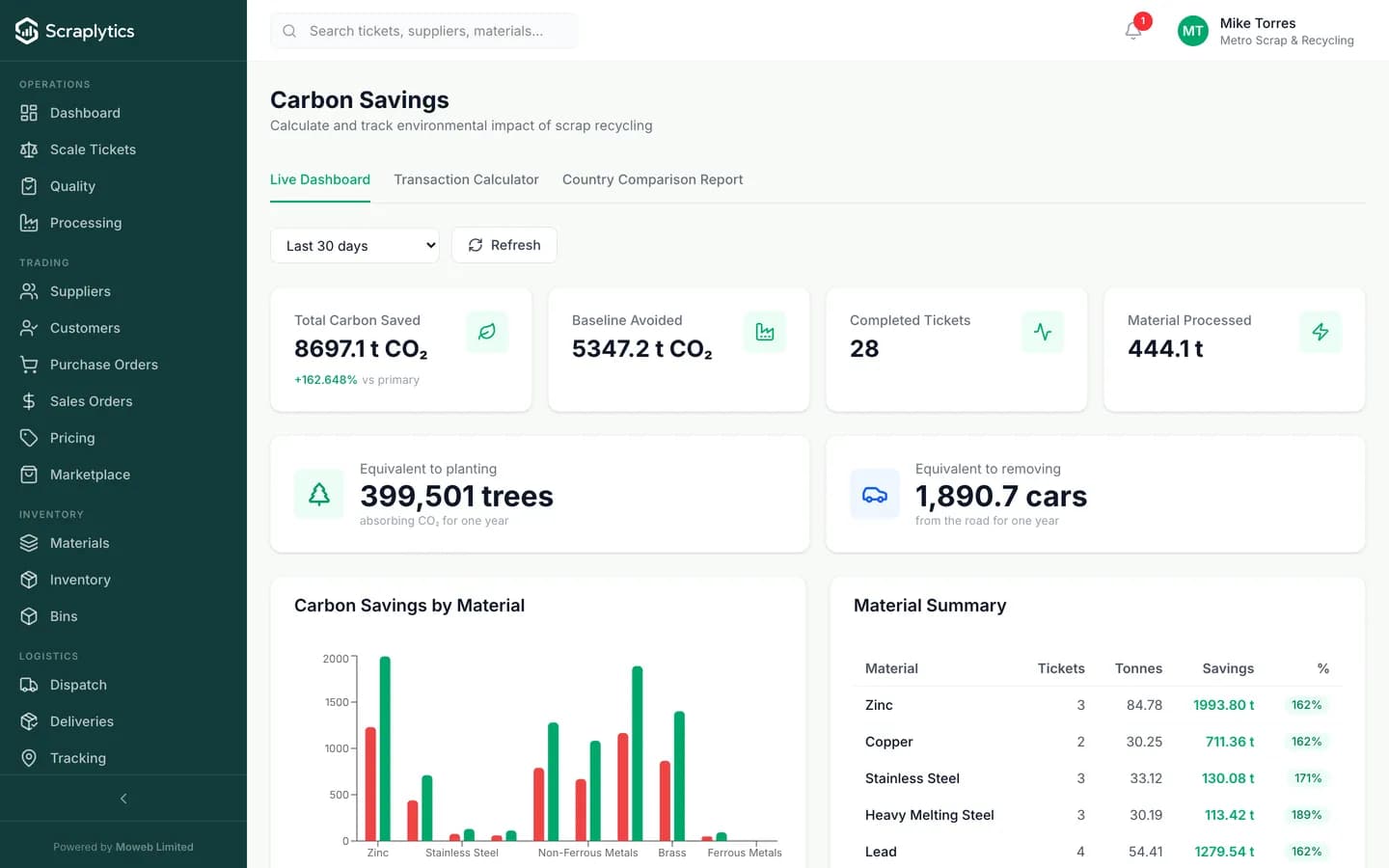
CO2, diversion and energy-saved equivalences from real transactions.
Why carbon tracking software is now a procurement requirement
Major brands now require Scope-3 reporting from their materials suppliers. Recyclers without a real sustainability number lose tenders to recyclers who have one.
Customers and investors ask for sustainability numbers. You guess based on industry averages, paste them into a PowerPoint and hope the number does not get audited.
Every ton processed posts a CO2-avoided number computed from current conversion factors. Year-end numbers are the sum of actual transactions, not a spreadsheet guess.
A downstream brand asks for a per-shipment sustainability certificate so they can claim recycled content in their ESG report. You have to manually assemble the proof.
Each sales order can generate a one-click sustainability certificate: tonnage, source mix, CO2 avoided, landfill diverted, signed by your business. The downstream brand attaches it to their filing.
You want to compete for ESG-mandated tenders (Apple, IKEA, automotive OEMs) but you cannot answer their sustainability questionnaire with audit-grade numbers.
The platform produces GRI, CDP and ISSB-compatible exports straight from your transaction data. Tender questionnaires get answered with real numbers, not extrapolations.
Inside the sustainability engine
Conversion factors that match your jurisdiction and your materials
Default conversion factors come from the EPA WARM model and the equivalent EU / UK / India / UAE standards. Every material has a configurable CO2-per-ton-recycled value vs virgin production. You can override the default with your own LCA study if you have one. The factor used is recorded on every transaction so the math is auditable.
Customer-facing certificates that hold up in their audits
When a customer wants to claim recycled content in their own ESG report, they need attestable inputs. Scraplytics generates per-shipment certificates with the tonnage, the source-supplier mix, the CO2-avoided computation, and a digital signature. These map cleanly to the inputs an ESG auditor will ask for.
ESG exports for GRI, CDP, ISSB and customer questionnaires
Standard exports cover the metrics tenders and frameworks ask for: total CO2 avoided, landfill diversion rate, recycled-content tonnage by material, energy-saved equivalences, and supplier-scope reporting. Custom export templates can be added for specific customer questionnaires you face repeatedly.
What you get
Frequently asked questions
Are your CO2 numbers audit-grade?+
They are as audit-grade as your underlying transaction data, since the math is transparent and the conversion factors are documented standards (EPA WARM by default). Most third-party ESG auditors will accept the methodology; we provide the documentation pack they need.
Can I use my own LCA conversion factors?+
Yes. If you have run a life-cycle assessment study or your regulator mandates specific factors, you can override the defaults per material. The factor used is recorded on every transaction for traceability.
How do I generate a sustainability certificate for a customer?+
From any sales order or completed shipment, click "Sustainability Certificate". A branded PDF is generated with the tonnage, source mix, CO2 avoided and digital signature. Customers can verify the PDF via a QR code linking back to your tenant.
Does this work for multiple jurisdictions?+
Yes. Each tenant configures its jurisdiction(s) and the matching set of default conversion factors. Multi-region operations can report by region or consolidated, depending on the framework being satisfied.

Ready to modernize your scrap yard?
Start your 14-day free trial today and be writing digital tickets by tomorrow. No credit card, no contract.
- No credit card required
- 14-day free trial
- Cancel anytime