
A Scrap Yard API that talks to your stack
The Scraplytics scrap yard API and webhooks: full REST, OpenAPI 3 schema, signed event delivery. Integrate accounting, ERPs, IoT scales and downstream buyers without an EDI consultant.
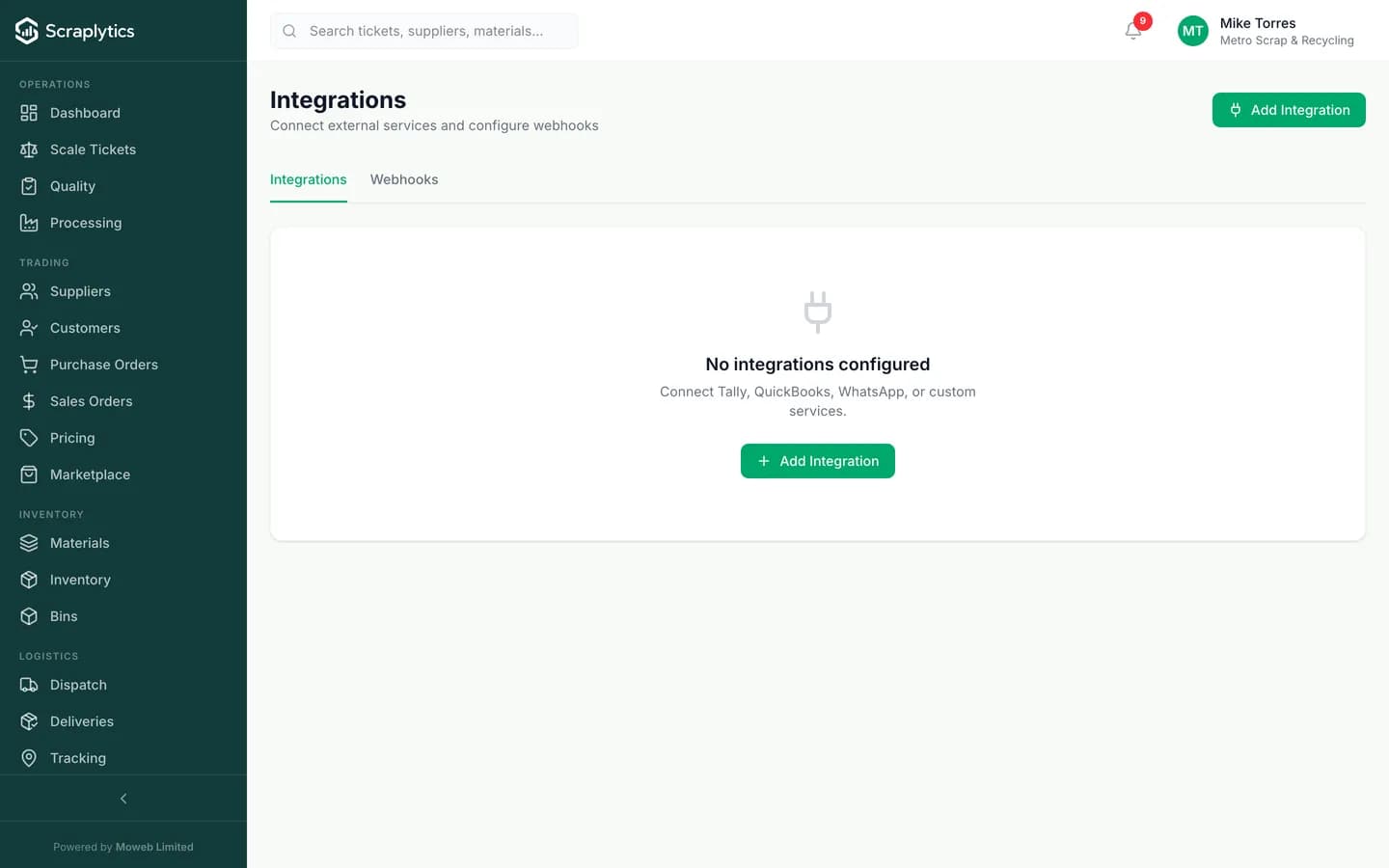
API keys, webhooks, delivery log - all in one place.
Why a real scrap yard API changes what is buildable
Most scrap-yard software trapped your data inside it. Scraplytics is a platform you can build around. That changes which problems become solvable.
You bought scrap-yard software that lives in its own walled garden. Your accounting team types every invoice into QuickBooks by hand because there is no export.
Every Scraplytics object has a REST endpoint and a webhook event. The accounting integration syncs invoices to QuickBooks in real time. No daily exports, no copy-paste.
Downstream buyer wants a real-time feed of incoming bales so they can plan their melt schedule. Nobody wants to email PDFs every day; nobody can build the integration because the system has no API.
Point the buyer at the production webhook for outbound lots. Their ERP receives a signed JSON payload the moment a bale is ready. Their melt schedule plans itself. You become the easy supplier to work with.
IoT scale or sensor vendor builds devices you would love to integrate but you cannot because there is no programmatic ingestion endpoint.
Devices POST to the weighbridge ingest endpoint with a signed payload. The platform validates, posts to the open ticket, and the cashier sees the captured weight live. Every weighbridge protocol becomes a one-day integration.
Inside the API platform
OpenAPI 3 schema with code samples for every endpoint
The full API is documented as OpenAPI 3. Generate clients in your language of choice (Python, Go, Node, Java, PHP, Ruby). The docs at api.scraplytics.com cover every endpoint with request/response examples, curl invocations and code snippets. The schema is versioned - breaking changes ship under a new version with at least 6 months of overlap.
Webhooks that survive your downstream system going dark
Every domain event (ticket.processed, invoice.paid, dispatch.completed, deal.confirmed, ...) can fire a webhook to URLs you register. Deliveries are HMAC-signed so receivers can verify authenticity. Failed deliveries retry with exponential backoff for up to 24 hours; failures and replays are visible in a delivery log so you can debug integrations.
API key scoping that respects production safety
Keys are scoped to specific operations (read scale-tickets, write invoices, admin tenant) and can be IP-allowlisted. Rate limits are configured per key. Rotation is a one-click operation that issues a new key, marks the old one for sunset, and audits every use. Lost a key? Revoke it from the Settings page in two clicks.
What you get
Frequently asked questions
Is the API included or is it a paid add-on?+
API access is arranged with our team when your account is set up. Ask us about rate limits and key scopes for your integration before you build.
What authentication does the API use?+
Bearer tokens (API keys) over HTTPS. OAuth 2.0 is available for user-context integrations where the integration should act as a specific user.
How do webhooks handle our endpoint being temporarily down?+
Webhook deliveries are queued. We retry with exponential backoff for up to 24 hours (1m, 5m, 30m, 1h, 4h, 12h). If your endpoint is still failing after 24 hours, the delivery is parked in the delivery log so you can replay it manually once the issue is fixed.
Can I run the API in our private network for an Enterprise deployment?+
Yes. Enterprise can deploy Scraplytics in a VPC of your choice with the API accessible only inside your network or via private link. Webhook destinations remain configurable so you can integrate with external systems where needed.

Ready to modernize your scrap yard?
Start your 14-day free trial today and be writing digital tickets by tomorrow. No credit card, no contract.
- No credit card required
- 14-day free trial
- Cancel anytime